
Iran intelligence update
Why Kharg Island matters

I was in the 101st Airborne Division (at Ft. Campbell, Kentucky) which, along with the 82nd, is part of the 18th Airborne Corps. The 18th Airborne Corps is a rapid-deployment force. They have parachute and air assault (inserting troops via rappelling from helicopters) infantry units.
Donald Trump has dementia, poor impulse control, tangential thinking, and rapid shifts of affect - all compounded by profound personality pathology. He is totally unpredictable due to his severe mental illness. And he is a pathological liar.
That said, I doubt he plans a land invasion of Iran. The coast of Iran in the Persian Gulf and the Gulf of Oman are ringed with mountain chains which would make and amphibious invasion difficult.
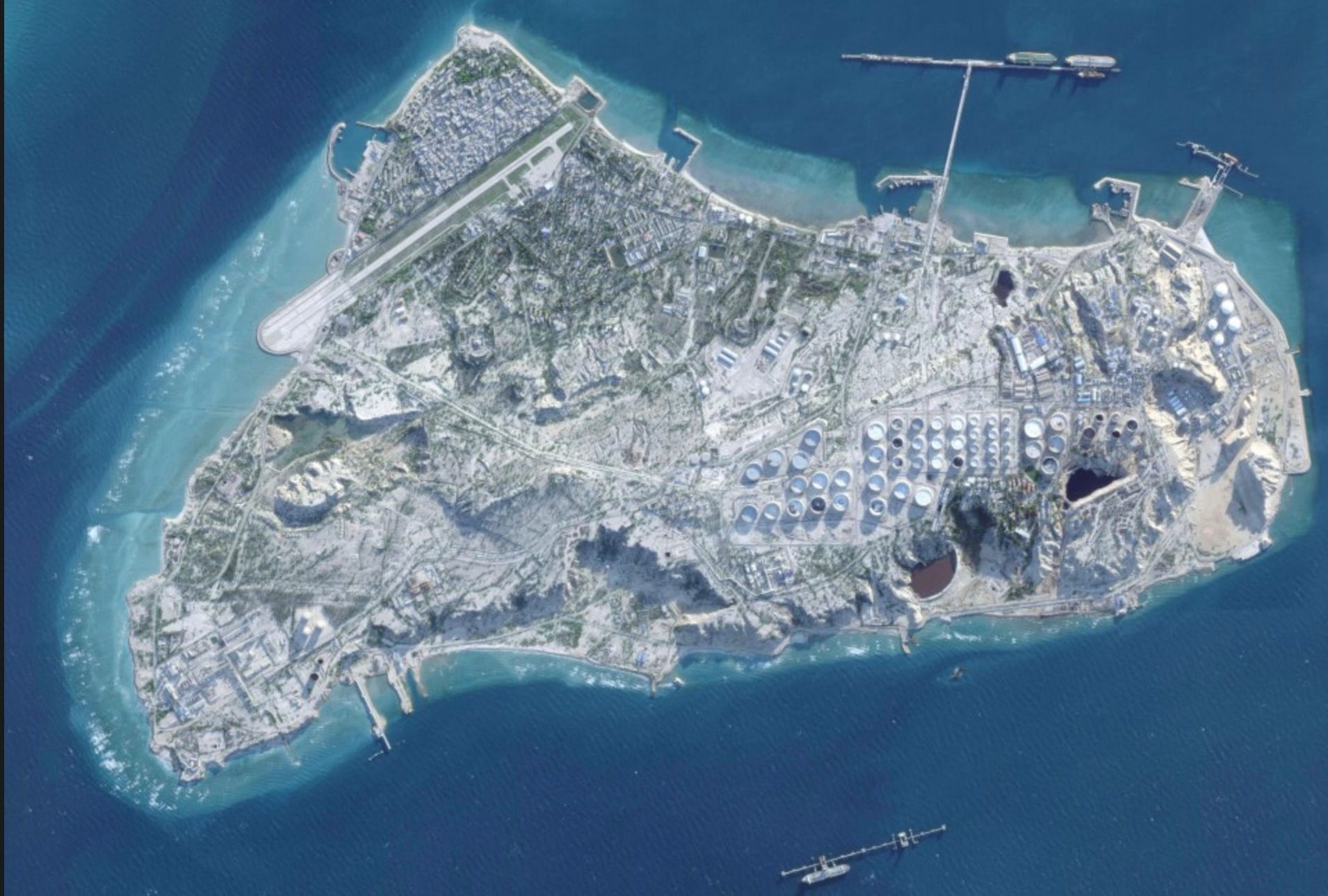
Given the number of Marines and Army personnel being deployed, my guess is he will try to secure Kharg Island, a small, mostly flat, coral island which is 25 km (16 miles) off of the coast of Iran and 660 km (410 miles) north of the Straight of Hormuz. This island provides a sea port for the export of up to 90% of Iran’s oil products, as well as supplying storage for up to 30 million barrels of oil.
Kharg Island has an airport known as Kharg Airport, which serves as a regional airport for the area. It is used primarily for transferring employees of the Iran Oil Company and is operated by the Iran Airports Company.
Control of Kharg Island would provide a base of operations for aircraft and naval assets to attempt to re-open the Strait of Hormuz. Iran has a ballistic missile program (the largest in the Middle East) and drones. So, any attempted aerial and amphibian invasion of Kharg island poses significant risks. Also, one direct hit by one missile could set the island (which has large quantities of highly flammable materials) on fire. Kharg Island has an area of only 20 square kilometer (7.7 square miles) and is covered with fuel storage facilities. So this island could be set ablaze.
As a last resort, Iran could destroy the airport and the docks making use of these resources by U.S. impossible. Iran is building up defenses of Kharg Island to protect against a potential US ground attack. Iran has been laying traps and moving additional military personnel and air defenses to Kharg Island in recent weeks in preparation for a possible US operation to take control of the island.
The island has layered defenses, and the Iranians have moved additional shoulder-fired, surface-to-air guided missile systems known as MANPADs there in recent weeks. They have also been laying traps including anti-personnel and anti-armor mines around the island.
The island was bombed by the U.S. military recently. They targeted military facilities while mostly sparing the oil infrastructure itself. This was a significant move against Iran’s economic lifeline, as the island is vital for the country’s oil exports.
Anti-missile equipment and naval assets have been pulled out of Asia for deployment to the Middle East. I wouldn’t be surprised if North Korea became aggressive with South Korea, or China with Taiwan. And there will be less military materiel sent to Ukraine, leaving it vulnerable to the machinations of Trump’s best friend Vladimir Putin.
Air defense is costly. Hundreds — if not thousands — of Patriot missiles have been used by the U.S. and its allies across the Middle East to defend against Iranian missiles and drones. The cost of a Patriot missile system can vary significantly, but a single missile typically costs around $3 million to $4 million. The overall cost of the entire Patriot missile system, including launchers and support equipment, can exceed $1 billion.
Iranian drones, particularly the Shahed-136, are known for their low production costs (about $20,000). This cost-effectiveness allows Iran to deploy them in large swarms, making them a significant threat in modern warfare by overwhelming more expensive air defense systems.
Iran’s cluster bombs are successfully penetrating Israel’s iron dome. Cluster bombs disperse munitions over a wide area and are particularly dangerous for civilians.
So, the U.S. and Israel (which is committing genocide, war crime and child murder in Lebanon - Israel has just ordered the evacuation of Beirut) are using multimillion dollar missiles to should down cheap, $20,000 drones. The U.S. is sending the Merops anti-drone system to the Middle East after its success in Ukraine, which uses AI to identify and neutralize drones cost-effectively. This system is designed to counter cheap, hard-to-detect drones like Iran’s Shahed models, which pose a significant challenge to traditional missile-based defenses.
But there is not an unlimited supply of Patriot Missiles or Merops systems. And the Iranians are masters at conducting long wars of attrition. Israel has announced it plans on continuing their attacks on Iran for a a few more weeks. Any talk by Trump of a cease fire agreement with Iran that leads to cessation of hostilities (which are costing over one billion a day) is premature.
I have no idea where Iran stashed their estimated 500 kg (1,100 pounds) of enriched, weapons grade uranium which would fit into one of Trump’s bathrooms at Mar A Lago in a country of 1,648,195 square km or 636,372 square miles. I could see Trump sending Seal Team 6 to retrieve these canisters, but they would need special training on how to handle these items. They could use a CH-47 Chinook helicopter (which can carry loads exceeding 1,100 pounds, with a maximum payload capacity of up to 36,000 pounds depending on configuration). The CH-47 Chinook has a maximum airspeed of approximately 170 knots, which is about 200 miles per hour (310 kilometers per hour). This makes it one of the fastest helicopters in the U.S. inventory. But even at that speed, these helicopters are vulnerable (and they are not pressurized and can only fly at a maximum operational altitude of 6,100 meters - 20,000 feet). Damage to one of the two propellors can bring a Chinook down.
I have a feeling the U.S. doesn’t know where this enriched nuclear material is located, especially after they claimed to obliterate Iran’s nuclear program in June 2025. It could be moved quickly in a heavy duty van or truck and concealed very easily.
The United States has never had such cruel, hateful, incompetent, emotionally immature, mentally disturbed and sadistic leadership in its entire 250 year existence as Donald Trump. That is a major liability. He is getting thousands of people killed and causing major harm to the global economy.
Russia’s attacks on Ukraine’s civilian infrastructure, including energy facilities, have been described as war crimes by the office of the United Nations High Commissioner for Human Rights and Amnesty International. if Trump carries out his threats to destroy Iran’s electric power facilities he would would unleash catastrophic harm on millions of civilians.
The Geneva conventions and additional protocols shaped by international courts say that parties involved in a military conflict must distinguish between “civilian objects and military objectives” and that attacks on civilian objects are forbidden - a war crime.
This prohibition is also codified in the Rome Statute of the International Criminal Court (ICC).
Iran has several significant hydroelectric dams, including the Karun-3, Karkheh, and Dez dams, which play a crucial role in generating electricity and managing water resources. Bombing hydroelectric dams would leave to massive civilian casualties by drowning and flooding.
The U.S. did not deliberately bomb the dams in North Vietnam, although there were instances of accidental damage to some dikes near military targets during the Vietnam War.
Republican President Richard Nixon and his administration considered bombing the dike network, but it was ultimately rejected due to concerns about the humanitarian impact.
This taped, 1972 conversation between Republican President Richard Nixon and Secretary of State is bloodthirsty and very telling :
Nixon: We’ve got to quit thinking in terms of a three-day strike [in the Hanoi-Haiphong area]. We’ve got to be thinking in terms of an all-out bombing attack - which will continue until they - Now by all-out bombing attack, I am thinking about things that go far beyond. I’m thinking of the dikes, I’m thinking of the railroad, I’m thinking, of course, the docks.
Kissinger: I agree with you.
Nixon: We’ve got to use massive force.
Nixon: How many did we kill in Laos?
Press Secretary Ron Ziegler: Maybe ten thousand - fifteen?
Kissinger: In the Laotian thing, we killed about ten, fifteen.
Nixon : See, the attack in the North that we have in mind, power plants, whatever’s left - POL [petroleum], the docks. And, I still think we ought to take the dikes out now. Will that drown people?
Kissinger: About two hundred thousand people.
Nixon: No, no, no, I’d rather use the nuclear bomb. Have you got that, Henry?
Kissinger: That, I think, would just be too much.
Nixon: The nuclear bomb, does that bother you?...I just want you to think big, Henry, for Christsakes.
Would any of the sycophants in the in the Trump White House tell him his actions could just be too much?
Iran has one operational nuclear power plant at Bushehr and is constructing another unit there. Additionally, Iran has several facilities involved in the nuclear fuel cycle. Any bombing of these structures could create a Chernobyl-level, environmental disaster and could lead to a public health crisis among Iranian civilians in proximity to these plants.
An Iranian missile recently hit the Israeli town of Dimona, near the site of a nuclear facility, in what Iran said was retaliation for strikes on its own nuclear site at Natanz.
Iran has threatened to retaliate by destroying (irreparably) similar infrastructure in neighboring countries allied with the U.S. (power plants and desalinization plants). This could leave much of the Middle East in darkness, thirsty, and unable to pump and process petroleum.
U.S. military personnel in the Persian Gulf face unique and stressful challenges. There are 4,500 Marines already in the Persian Gulf. The 82nd Airborne Division is part of the Immediate Response Force, which can deploy within 18 hours, making it one of the fastest-response units in the U.S. military. I don’t know how many soldiers with the 82nd are being deployed. In this situation, I would recommend an overwhelming contingent of 10,000 personnel for this operation. But I don’t advocate or support this war.
Rapid deployments may lead to logistical challenges and operational difficulties in unfamiliar environments. Also, the acclimation from cooler temperatures in Fort Bragg, North Carolina (the 50s and 60s) to very hot weather in the Persian Gulf is difficult (especially in a limited time frame of less than 24 hours).
The average combat load for a U.S. Marine, including a rifle and personal protective equipment, typically weighs around 43 pounds. They have to wear heavy, kevlar helmets which are about four pounds. They have to have sleeves down. Boots are about five pounds. This is very difficult in not weather especially coming from a cooler climate. Iran has been reported to develop biological and chemical weapons, particularly during the Iran-Iraq War from 1980 to 1988. They continue to work on enhancing their capabilities in these areas. Despite being a party to the Chemical Weapons Convention, there have ongoing concerns about Iran's compliance and the potential use of such weapons in regional conflicts.
U.S. military personnel will have MOPP Gear (Mission Oriented Protective Posture). This safeguards troops against chemical, biological, radiological, and nuclear (CBRN) threats - various levels of protection, with each level requiring different items to be worn or carried, such as full-body, heavy charcoal lined suits, gas protective masks, gloves, and special boots. It is hot as hell under all of this heavy, air tight gear, almost unbearably so. Decontamination procedures are cumbersome.
Many people developed Gulf War syndrome after Desert Storm in 1991. The exact causes were never fully understood, but exposure to certain chemicals and nerve agents during the war is believed to play a significant role. Many people became very ill and some died.
During the Gulf War Iraqi forces set fire to around 700 oil wells in Kuwait as they retreated from advancing coalition forces. This environmental warfare tactic was intended to hinder military operations and punish Kuwait for its oil production policies. I think these fires made people sick. This is a major health risk in this current war.
There is also heavy rain (up to eight inches expected) forecast in the region later this week. This can make for rough water (which would be a hindrance to an amphibian landing). And limited visibility, high winds and intense rain could make air operations hazardous. I have a feeling that the Pentagon is not paying attention to the weather forecast.
I usually don’t write on military topics (I am more focused on spirituality), but a number of people have asked me about the deployment of Marines and the 82nd Airborne to the Persian Gulf, and to give an assessment of where I think things are headed. I think a land invasion of Kharg Island is imminent.
Brig not bright.
Many years ago I took an upper division class at university. It was Theory & Dynamics, an ROTC class covering international relations and the UCMJ . A military briefing was required, my topic was this very problem. My conclusion was that it was a no win scenario and the only logical solution was green energy and an end to fossil fuels dependency. Here we are. I was offered a commission but turned it down. My feeling was that acceptance would result in bright time before I finished boot camp. In retrospect, one of my better decisions.